


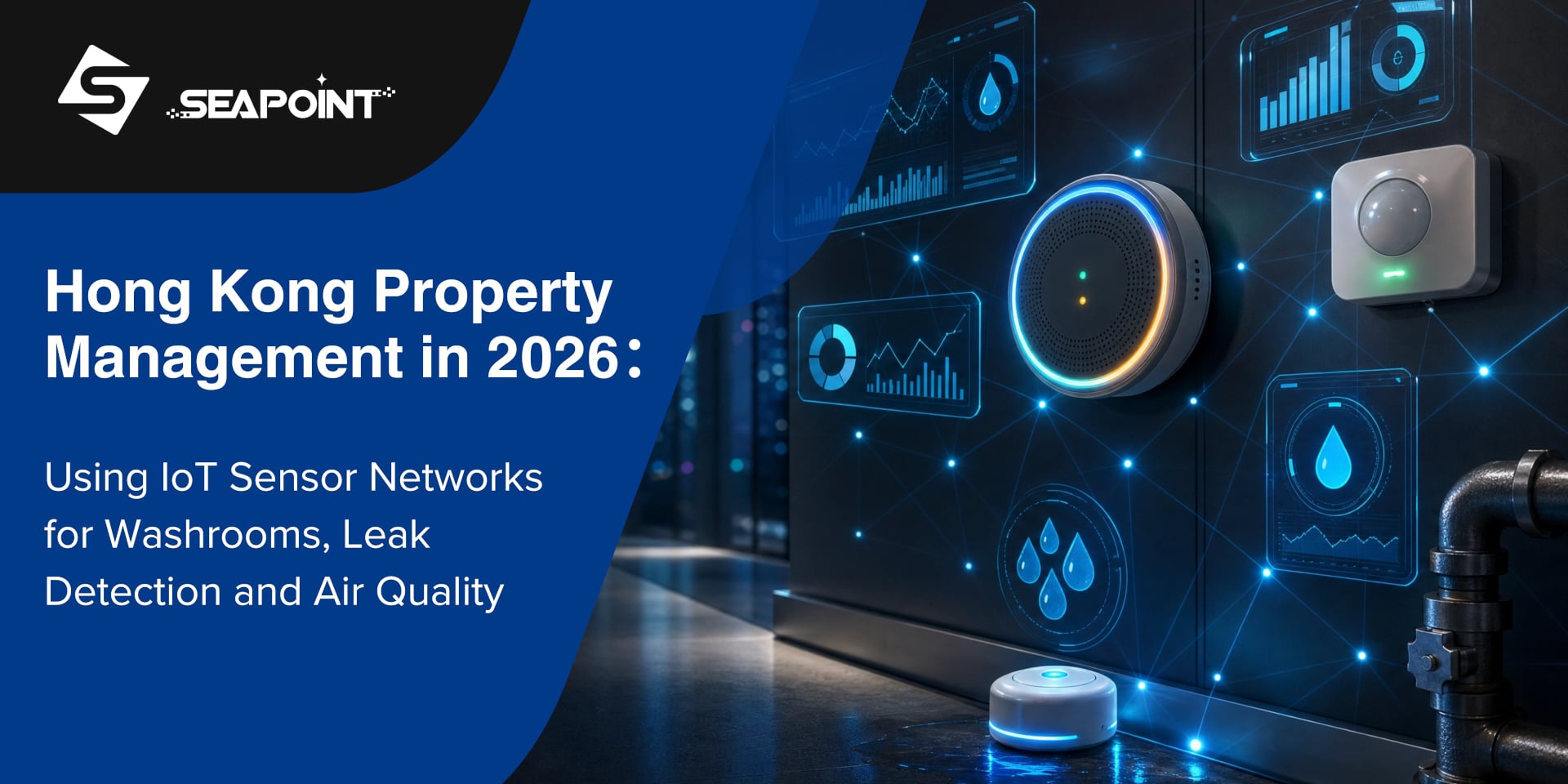
Property management in Hong Kong has never been more demanding. Labour costs keep climbing, tenants expect higher hygiene standards, and the Hong Kong Smart City Blueprint has steadily raised expectations for what "well-managed" actually means. Based on the Sea Point team's hands-on experience across commercial property projects in the city, the most effective approach in 2026 isn't deploying one smart system at a time. It's building a connected IoT sensor network that ties Innovative Washroom Management Systems (IWMS), water leak detection and indoor air quality (IAQ) monitoring into a single, data-driven platform. When these three systems work together, property managers stop reacting to complaints and start preventing them.
What Is an IoT Sensor Network, and Why Does Hong Kong Property Management Need One?
An IoT sensor network connects building sensors across multiple facility types to a unified management platform, enabling real-time monitoring, automated alerts and data analysis that replaces manual inspection routines.
The problem with traditional property management is well known to anyone who's worked in the industry: cleaning rounds happen on a fixed schedule, not on demand. A washroom runs out of paper or soap between rounds. A pipe starts leaking behind a wall cavity. An air conditioning system recycles stale air all afternoon. None of these issues get noticed until someone complains, and by then the damage, literal or reputational, has already happened.
IoT sensor networks change that dynamic. Sensors run continuously, feed data to a central platform, and flag anomalies the moment they appear. The facilities team gets a push notification on their phone before the problem escalates. This isn't theoretical; it's how properties running modern smart building IoT solutions operate day to day. A recent Sea Point project deployed IWMS for a multi-disciplinary organisation in Hong Kong, illustrating how connected sensor networks reshape day-to-day facility operations.
In 2026, the question for Hong Kong property managers isn't whether to deploy IoT sensors, but which systems to integrate first and how to get them talking to each other on a single platform.
Innovative Washroom Management Systems: The First Node in Your IoT Network
An Innovative Washroom Management System (IWMS) uses sensors installed throughout washroom facilities to monitor cubicle occupancy, consumable levels, hygiene conditions and visitor flow, with all data feeding into a central management platform.
Sea Point's Innovative Washroom Management Systems cover a broad range of monitoring functions in one deployment:
- Cubicle occupancy detection: Infrared sensors track which cubicles are in use and connect to entrance display panels that guide visitors to available spaces, cutting queue times and reducing congestion
- Consumable monitoring: Toilet paper, soap and waste bin sensors alert cleaning staff before supplies run out, not after the first complaint comes in
- Environmental sensing: Ammonia (NH3), hydrogen sulphide (H2S), temperature and humidity readings trigger ventilation systems automatically when thresholds are crossed
- Water detection: Floor-level water sensors flag spillages and potential leaks immediately, with precise location data pushed to the cleaning team's mobile app
- Staff management: Automated attendance logging for cleaning personnel, providing management with shift data for scheduling and performance reviews
It's worth noting that the air quality readings captured inside washrooms, particularly ammonia and TVOC levels, feed directly into the broader IAQ picture for the building. That cross-system data relationship is what makes integrated deployment more valuable than running each system in isolation.
IoT Water Leak Detection: Stopping the Problem Before It Becomes a Crisis
IoT water leak sensors are compact devices placed at high-risk points throughout a building (pipe junctions, equipment rooms, ceiling voids) that detect moisture at the earliest stage and send immediate alerts before damage can spread.
Ageing building infrastructure is a real issue across Hong Kong's commercial stock. In addition, the city's humid subtropical climate and the condensation that comes with it make water ingress one of the most common, and most expensive, building maintenance problems. The catch is that many leaks develop in concealed locations: under raised flooring in server rooms, inside ceiling cavities, in pipe risers tucked behind plasterboard. By the time a leak is visible, it's already caused significant damage.
Sea Point's IoT water leak detection solutions use low-voltage wireless sensors that can be deployed across a building's most vulnerable points:
- Data centre and server room raised floors
- Air conditioning units and cooling tower bases
- Main pipe junctions and valve points on each floor
- Pipe risers adjacent to washroom blocks
- Kitchen and food and beverage drainage areas
When a sensor detects moisture, the platform pushes an alert within seconds, with timestamp and location data logged automatically. That record proves valuable beyond the immediate repair: it supports insurance claims, informs planned maintenance schedules and helps management identify which sections of ageing infrastructure need priority replacement.
And when washroom water leakage sensors and building-wide leak detectors share a single backend, the property team gets a complete picture of water risk across the building, without toggling between separate platforms. Sea Point recently deployed IoT water leak sensors across a Hong Kong residential property complex, illustrating how preventive monitoring works in a real-world multi-block environment.
A water leak alert costs seconds to act on. An undetected leak costs weeks of disruption and bills that can run into six figures. The return on preventive IoT monitoring typically shows up the first time a sensor catches something a routine inspection would have missed. — Sea Point technical team
Indoor Air Quality Monitoring: The Third System Too Many Buildings Are Missing
Indoor air quality (IAQ) monitoring means using sensors to continuously track CO2, PM2.5, TVOC, formaldehyde, temperature and humidity levels inside a building, ensuring conditions stay within healthy and compliant ranges.
Hong Kong's Environmental Protection Department IAQ Management Guidelines set benchmarks for offices and public spaces covering CO2, TVOC, PM2.5 and other key indicators. Breaching these guidelines isn't just a health issue; it carries legal exposure and reputational consequences for building management.
The problem with annual third-party IAQ audits is that air quality is dynamic. A snapshot taken on one day of the year can miss seasonal patterns, occupancy spikes or ventilation failures that create chronic problems the rest of the year. Continuous IoT monitoring catches what audits can't:
- CO2 spikes in meeting rooms and dining areas: Occupancy-driven CO2 build-up can happen quickly in enclosed spaces. Sensors trigger fresh air supply adjustments automatically before occupants start feeling the effects
- Ammonia and TVOC migration from washrooms: Insufficient washroom ventilation allows pollutants to spread through shared ductwork or door gaps. IoT sensors pinpoint the source rather than just flagging that an area smells off
- Post-renovation off-gassing: New fit-out work or industrial cleaning products temporarily spike TVOC readings. Sensors log these events automatically, creating a record that management can reference when tenant queries arise
Integrated across IWMS, water leak detection and IAQ monitoring, Sea Point's smart building solutions give property teams a complete environmental health view of their buildings from a single dashboard. A recent Sea Point deployment for an academic institution's server room combined IoT water leak detection with IAQ monitoring, demonstrating how the two systems reinforce each other in mission-critical environments. That's what modern facilities management looks like in 2026.
What Does Integrated IoT Deployment Actually Look Like in Practice?
Deploying these three systems as a connected network, rather than three separate tools, changes the day-to-day experience for property managers in concrete ways:
- Single dashboard, full picture: All sensor alerts from IWMS, water leak detection and air quality appear in a single interface. No more logging into three separate systems to get a read on building conditions
- Cross-system data patterns: Washroom peak-hour usage data informs ventilation scheduling; leak event logs tied to maintenance records help identify which pipe sections need prioritised replacement; air quality trends correlate with occupancy data to optimise HVAC settings
- Smarter staff deployment: Cleaning schedules based on actual usage and consumable data rather than fixed rounds, helping management teams do more with a constrained labour pool
- Audit-ready records: All sensor data is logged automatically, making it straightforward to produce facility management reports for building owners, owners' corporations or external auditors
Sea Point provides end-to-end smart building IoT solutions across Hong Kong, handling everything from initial site assessment and system design through hardware installation, platform configuration and ongoing local technical support. Our team's experience spans commercial malls, hotels, Grade A offices and educational institutions, including a recently completed IWMS deployment for a multi-disciplinary organisation in Hong Kong.
Frequently Asked Questions
1. What exactly is an IoT sensor network for property management, and why does Hong Kong need it?
An IoT sensor network connects multiple sensor types across a building (Innovative Washroom Management Systems, water leak detectors, indoor air quality monitors) to a unified backend platform. Property teams get real-time facility status, automated alerts and data trends without relying on manual inspection rounds. For Hong Kong properties, this shifts management from reactive complaint response to preventive intervention, at a time when cleaning labour costs keep rising and tenant expectations keep climbing.
2. How much does deploying a full IoT sensor network typically cost?
Total investment varies by project and is driven by three main factors: building size and number of floors, the mix of sensor types deployed (washroom management, water leak detection, IAQ, or all three), and the complexity of integration with existing backend systems. Costs typically break down into hardware, software platform, installation and ongoing local support. Sea Point offers free on-site assessments and will provide a tailored quote based on your specific property, so booking a consultation is the most reliable way to get accurate numbers.
3. How long does deployment take from contract to go-live, and will it disrupt tenants?
Small-scale deployments (a single floor or specific zones) generally take 4-6 weeks. Mid-size commercial properties take 8-10 weeks, and larger multi-block developments 10-14 weeks. Sea Point's sensors mostly connect wirelessly and support drill-free installation, so the bulk of on-site work can be scheduled outside peak hours. Tenant disruption is minimal, and a detailed project schedule is provided before work starts so all parties can coordinate.
4. Can older commercial buildings retrofit an IoT sensor network?
Yes, and this is one of the strongest advantages of IoT networks. Sea Point's sensors are compact and connect wirelessly via LoRaWAN or Wi-Fi, so there's no need to modify existing pipe or cable infrastructure. Most models use adhesive or magnetic mounts that avoid drilling into existing structures. This makes retrofitting practical even for older commercial buildings and residential complexes, and it's an area Sea Point has substantial project experience in.
5. Why does indoor air quality monitoring matter for Hong Kong commercial buildings?
Hong Kong's EPD IAQ Management Guidelines set benchmarks for CO2, TVOC, PM2.5 and other pollutants in offices and public spaces. Falling short of these guidelines creates both legal exposure and reputational risk. Continuous IoT monitoring catches what annual third-party audits miss, including occupancy-driven CO2 spikes, washroom pollutant migration and post-renovation TVOC off-gassing. Sensors can also trigger ventilation systems automatically, reducing reliance on manual HVAC adjustments.
Ready to Upgrade Your Building's Facilities Management?
The gap between properties running connected IoT systems and those still relying on fixed cleaning rounds and annual audits is only going to widen. Sea Point's Hong Kong team works with property managers, facility directors and building owners to design IoT sensor networks that fit the specific layout, occupancy profile and budget of each building. We handle the full project lifecycle locally, from site survey and system design to installation, commissioning and support.
Our Hong Kong showroom has working demonstrations of Innovative Washroom Management, water leak detection and air quality monitoring systems. It's worth an hour of your time to see what integrated IoT facilities management looks like in practice. Get in touch or book a showroom visit to start the conversation with our technical advisors.


